Home / Mold
Mold Remediation in Appleton, WI
Someone has quoted you thousands for mold remediation and you do not know if you are being scammed, or if the quote was written to capitalize on your anxiety about mold. That suspicion is reasonable. Wisconsin certifies nobody to inspect or remove mold, and the state's Department of Health Services says testing is generally not necessary. Mold remediation in Appleton should mean three things: finding the moisture, removing what is contaminated, and fixing the cause so it does not return. We are a referral service and do no work ourselves. Call (920) 672-1283, press 1, and we connect you with a restoration company serving Appleton. Use this page to judge what they tell you.
Call (920) 672-1283Last updated October 6, 2026
If this sounds familiar
"I've never seen a mold inspector not find mold"
Mold spores are in every house. An air sample will always find some. The Wisconsin Department of Health Services puts it this way: "If you can see and smell mold in your home, mold is present." You do not need a lab to confirm what you can see, and a lab result does not tell you where the water is coming from, which is the only thing that matters for fixing it.
"The basement has a musty smell, kind of like old dirt"
Wisconsin summers are humid and basements are cool, so basement air is damp from May into October. Many owners here run a dehumidifier the whole season. A musty smell with no visible growth and no leak is usually a humidity problem, and the first step is a dehumidifier set around 50 percent, not a remediation crew.
"It's been close to 10 days after the leak"
This is the case to take seriously. The Environmental Protection Agency says materials dried within 24 to 48 hours will, in most cases, not grow mold. Carpet pad, drywall and insulation that stayed wet for a week and a half probably have.
Four things Wisconsin's health department says
All four come from the Department of Health Services guide to hiring a mold contractor, last revised December 2025.
- Nobody is "state certified". Neither the federal government nor the department certifies mold consultants or contractors. The department asks that anyone advertising as "State Certified" or "State Endorsed" be reported to consumer protection on 800-422-7128.
- "Testing for mold is generally not necessary." If testing is done, the lab should be accredited by the American Industrial Hygiene Association or the EPA.
- The tester and the remover should be separate. The firm doing the inspection or air sampling "should not be financially related" to the firm doing the repairs.
- "A building cannot be made mold free." Walk away from anyone who promises it.
The department's own advice on when to hire: for large mold problems, or when mold keeps coming back and the moisture source has not been found.
Call and we'll connect you with a restoration company serving Appleton.
Call (920) 672-1283The three fears, answered
"Around $20k for mold remediation. Don't know if I'm being scammed"
Compare it with a published range. HomeAdvisor's national guide, updated June 2026, gives an average of $2,368 and a usual range of $1,223 to $3,757, with professional testing at $250 to $800. A whole finished basement or an attic with rotten sheathing can cost several times that. A bathroom wall rarely should. Ask for the square footage being treated, what is being removed, and what is being done about the water. If the quote does not name the moisture source, it is a quote for cleaning, not for fixing.
"The inspection company should not also do remediation"
Homeowners say it and the state says it. If the same person who found the problem is selling the cure, get a second opinion from someone who is not. A general home inspector or a home performance consultant has nothing to gain from a large scope.
"Should I be worried?"
About your health, ask your doctor. A contractor is the wrong person. People with asthma or allergies react more strongly, and that is a medical question. About the house: mold on a bathroom ceiling is a ventilation chore. Mold spreading up from a basement floor or across attic sheathing is a moisture problem that will keep growing until the water stops.
Where mold turns up in Appleton houses
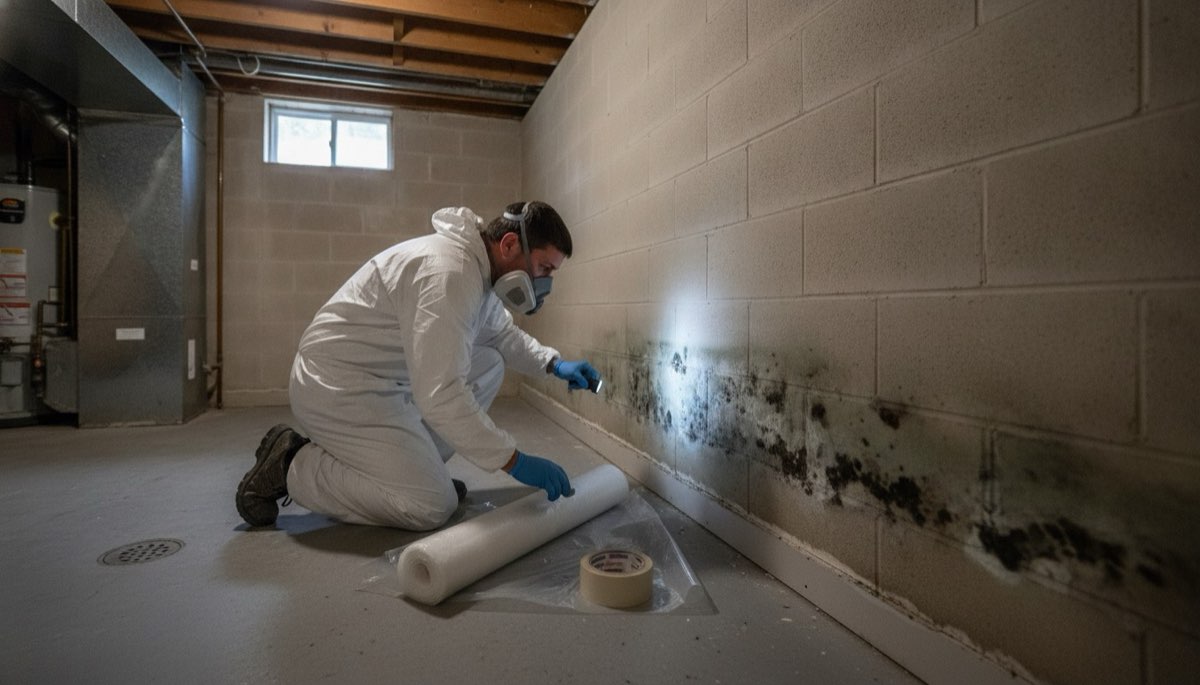
- The base of finished basement walls. Clay soil holds water against the foundation, and the bottom plate and the back of the drywall stay damp. Worth checking if your basement took water in the 2024 or 2026 floods and the wall was never opened.
- Attics and roof slopes. Wisconsin's health department names ice dams among the structural causes of mold. After a winter like 2025 to 2026, with a record March snowstorm, look at the sheathing above any ceiling stain.
- Behind a slow leak. Under a kitchen sink, behind a shower valve, below a window that weeps.
Ready to speak with a restoration company serving Appleton?
Call (920) 672-1283What proper remediation involves
Containment with plastic sheeting so spores are not spread through the house. Removal of porous material that is growing mold: drywall, insulation, carpet pad. Cleaning of the framing and concrete that stay. Drying. Then the repair to whatever let the water in. Ask for each of those as a line in a written scope.
Two Wisconsin rules can apply once walls are opened. In a house built before 1978, paid work that disturbs more than 6 square feet of painted surface in a room falls under the state's lead-safe renovation rule. And before disturbing materials other than wood, metal, glass or fiberglass, the state's asbestos guidance is to have them tested by a certified inspector or assume they contain asbestos. With six in ten Appleton homes built before 1980, both come up often.
Insurance
Homeowners regularly report mold claims denied under a mold exclusion in the policy. Whether yours pays tends to turn on what caused the moisture, since seepage through a foundation is not covered in the first place. Read the mold wording in your policy, or ask your agent to, before you file.
Questions homeowners ask
Is mold testing worth it or a waste of money?
For most homes it is not needed. Wisconsin's Department of Health Services says testing is generally not necessary, because if you can see and smell mold, it is there. Testing has a place when a buyer, seller or landlord needs a document, and then the lab should be accredited and the tester should not be the remediator.
Does bleach kill mold on drywall?
Only on the surface. Drywall is porous, and what has grown into the paper stays alive underneath. Moldy drywall is cut out and replaced. Bleach is for hard, non-porous surfaces such as tile.
Would a dehumidifier help with this?
For a damp, musty basement with no leak, yes, and it may be all you need. Keep the humidity at or below about 50 percent through the summer. It will not fix mold that is already growing in a wet wall.
How do we know if we did enough to prevent mold growth?
By measuring, not guessing. A moisture meter on the drywall, the bottom plate and the subfloor tells you whether they are dry. If you dried the room yourself after a leak, ask for readings before you close anything up.
Mold after a leak or a flood?
Call and we'll connect you with a restoration company serving Appleton. Press 1 when asked and have your zip code ready.
We are a referral service, not a contractor. The line is open 24 hours a day, every day, and your call is connected to an independent restoration company that serves Appleton.